



Jun 30 Dancing Fountains: How Design, Control, and Technology Transform Water into a Spectacle
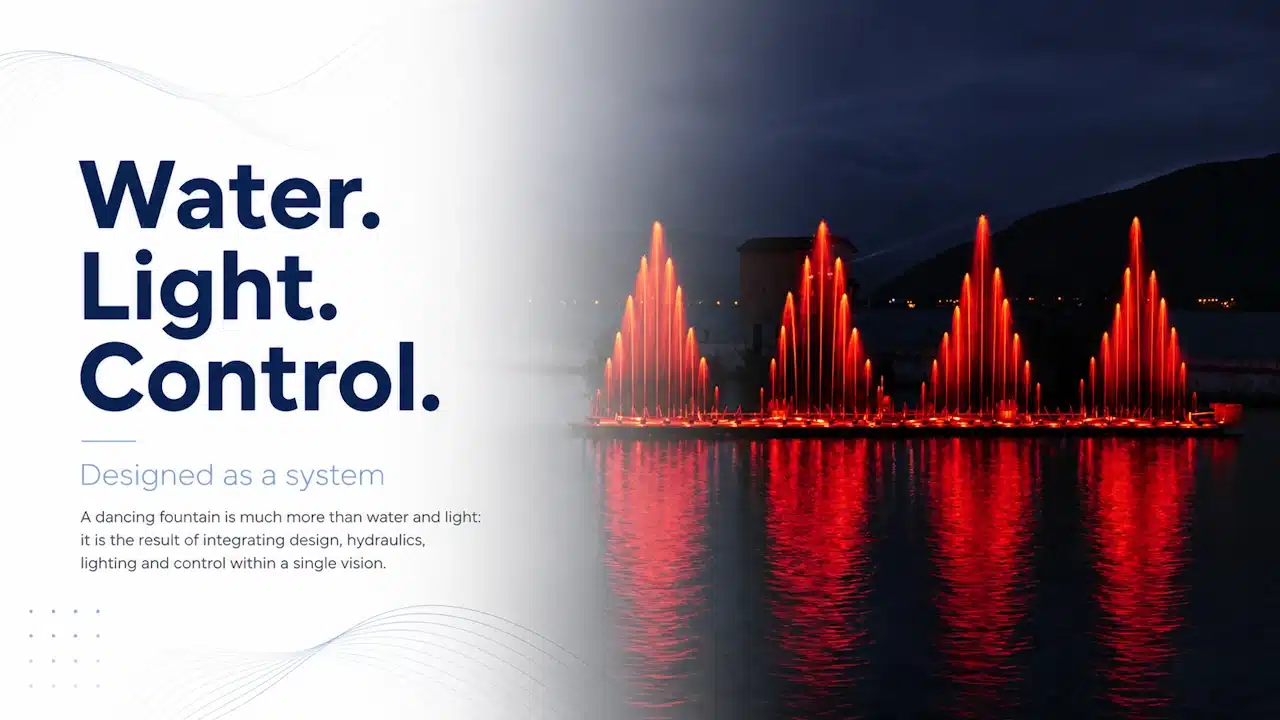
Dancing fountains and architectural fountains: not all demand the same technical complexity.
- dancing fountains represent the highest degree of complexity in the design of water feature fountains, however, not all projects necessitate the same level of control, automation, and technical coordination. Each installation's specifications are determined by its intended purpose, its operational environment, and, critically, the chosen typology. The design approach for a urban architectural fountain Intended for the continuous aesthetic enhancement of a space, as opposed to engineering a system capable of delivering a dynamic spectacle integrating water, light, and synchronization.
The distinction is not merely aesthetic; it directly dictates the system's complexity. From the conceptual phase, the selection of a typology—whether static, dynamic, or interactive—determines the entire technical architecture, the requisite control systems, and the integration methodology for the various components.
In the case of choreographed fountains, water transcends its role as a passive decorative element, evolving into a dynamic scenic resource. This demands the integration and synchronization of multiple systems—hydraulic, electrical, and control—under a singular operational framework. Consequently, the project's scope directly determines the requisite technical complexity.
What are the fundamental control requirements for each fountain type?
The key question is not what elements constitute an architectural fountain, but rather what needs to be controlled in each specific instance.
For a basic installation, system control can be limited to scheduled activation and deactivation. However, as the design's complexity escalates, so does the requirement for real-time management of multiple variables. The required level of control does not solely depend on the fountain's size, but primarily on the desired user experience and the degree of dynamism planned for the installation..
A modern architectural fountain, irrespective of its dynamic capabilities as a dancing fountain, incorporates numerous operational parameters:
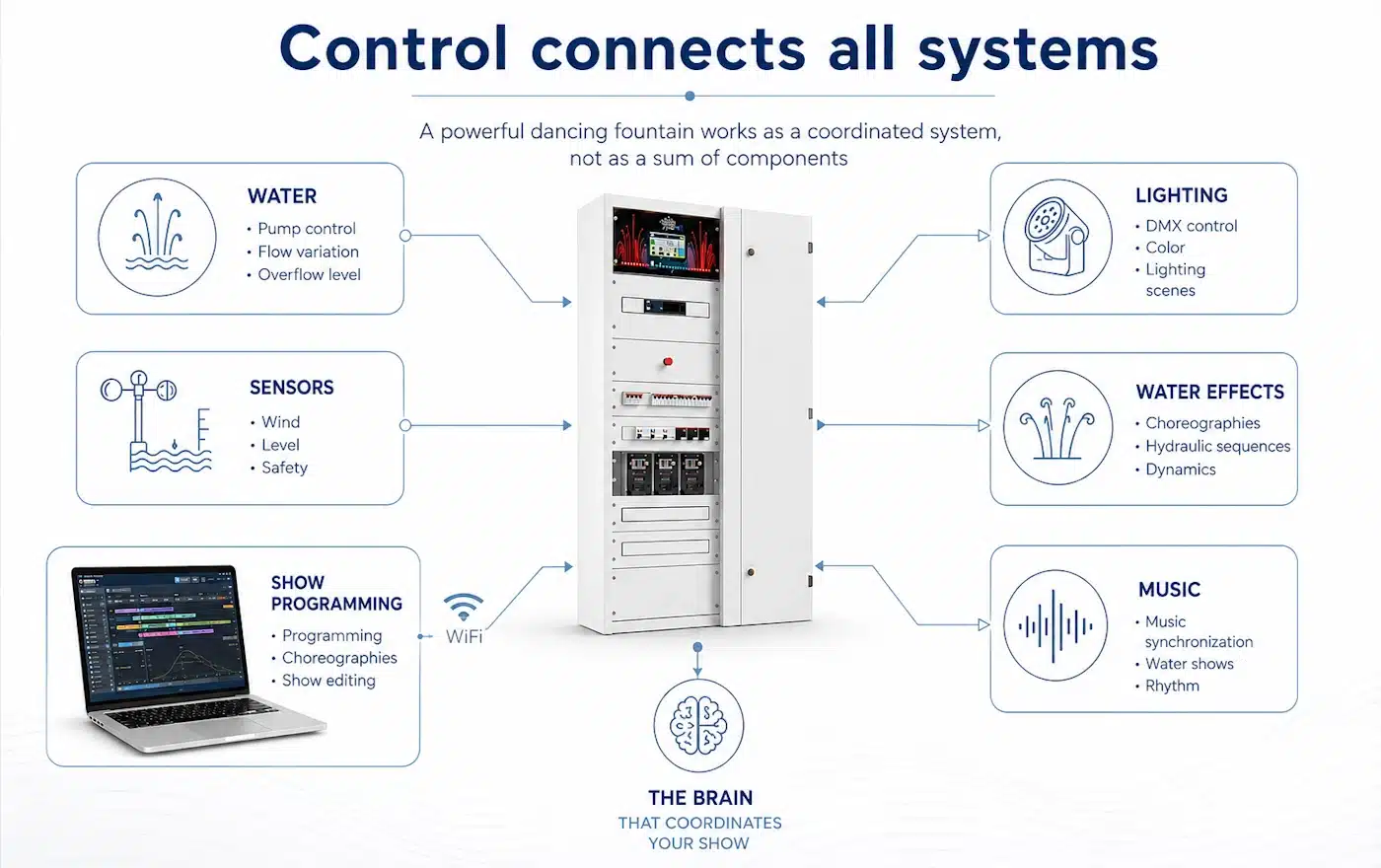
- Operation of water pumps and flow rate variation
- Activation of submersible solenoid valves
- Switching on and regulation of underwater lighting
- Response to sensors (wind control, water level)
Not all these parameters hold the same importance across all fountain typologies. In a classic architectural fountain installation, many of them may remain largely constant for extended operational periods. However, in a dancing fountain, where the design incorporates movement, intensity variations, or diverse visual sequences, the need for coordination among the various elements increases significantly.
For instance, a variation in the height of a water jet may necessitate a concurrent adjustment of the pumping flow rate, the actuation of specific valves, and a lighting adjustment to preserve the intended visual effect. As the number of water effects and the diversity of scenes increase, the system must manage a growing volume of commands and inter-equipment relationships.
Consequently, the control system transcends its role as a mere auxiliary component, evolving into an essential element of the project. It not only orchestrates the aquatic installation but also dictates its ability to adapt to environmental factors, respond to external stimuli, and precisely execute intricate sequences.
A dancing fountain as an integrated system
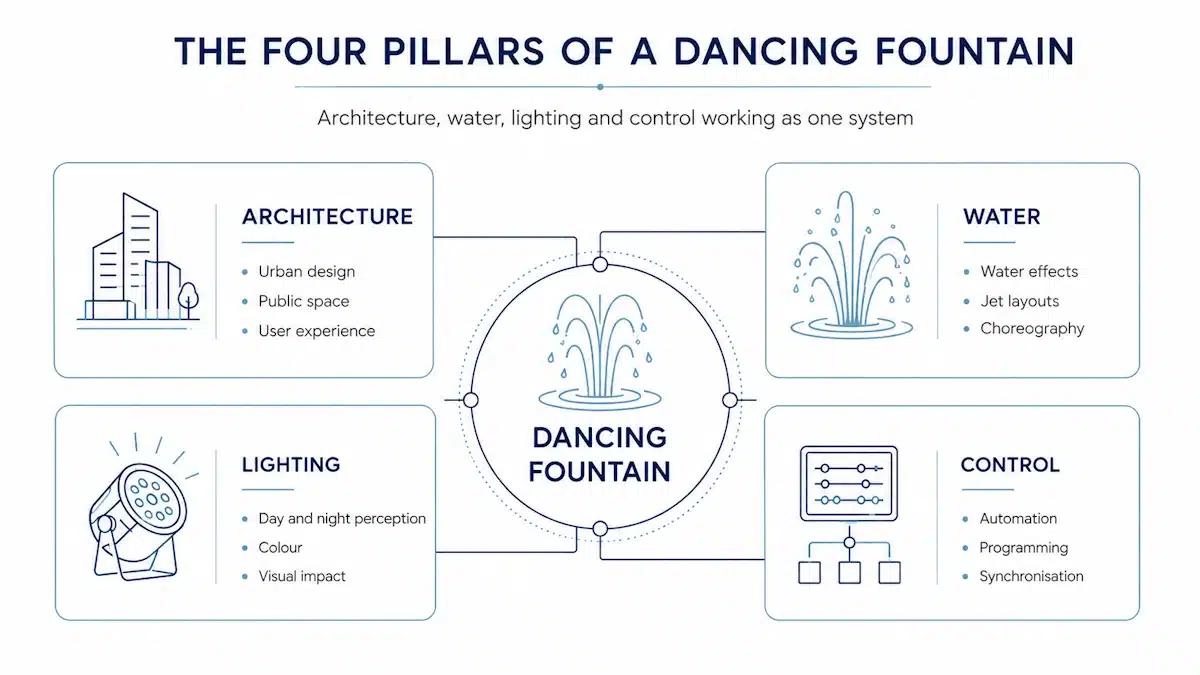
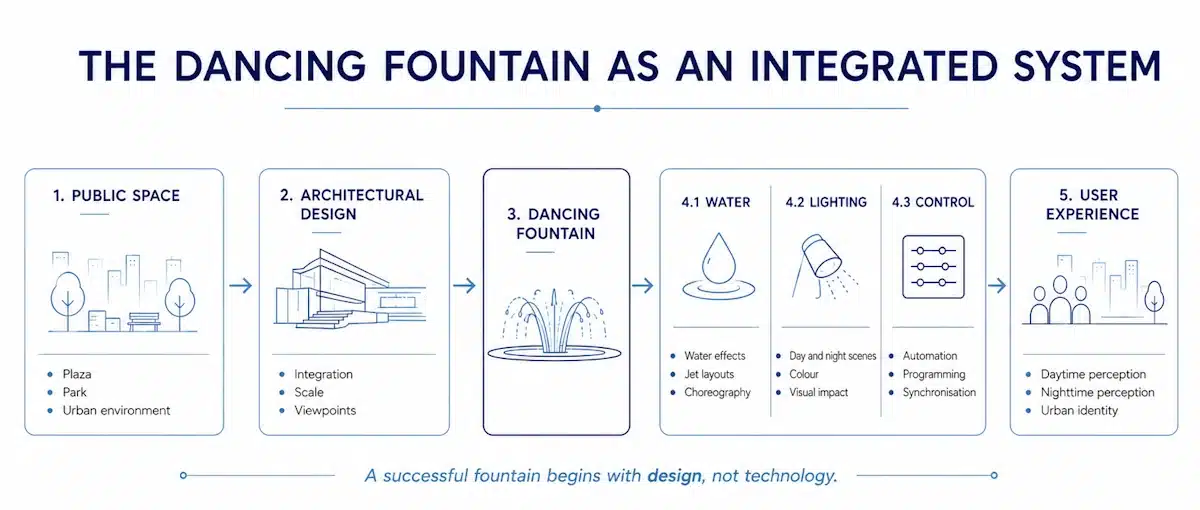
When a dancing fountain is integrated into a large-scale urban environment, its design must be approached with a comprehensive project vision. Rather than an isolated element, the fountain integrates into a system that interlinks public space, architecture, technology, and user experience.
The environmental context constitutes the foundational element
The surrounding environment consistently serves as the foundational premise. The specific plaza, park, or urban space designated for the installation dictates critical parameters such as the project's scale, pedestrian flow, primary sightlines, and the fountain's integration with existing architectural elements. Consequently, the site's attributes directly inform the design methodology.
The conceptual phase
Within this context, the conceptual phase must define the role of the dancing fountain within the overall scheme. A dancing fountain can function as an accompanying element or become the primary focal point of a public space. This decision will subsequently influence the scale of the water show, the visual intensity of the effects, and the manner in which users interact with the installation.
The dancing fountain as an integrated system: water effects, lighting, and control
Once its role within the project has been defined, the water show must be conceptualized as an integrated system comprising multiple subsystems. Water, lighting, and control operate in a coordinated manner to create a cohesive visual experience. The jet configuration, lighting, and system programming are not independent decisions, but rather integral components of a unified design strategy.
User experience is key
The ultimate outcome is perceived through the user experience. Factors such as observation distance, jet scale, diurnal and nocturnal perception, and integration with the urban environment determine how the fountain is experienced by the public. For this reason, the effectiveness of a dancing fountain does not solely depend on the dramatic impact of its effects, but also on its capacity to generate a proportionate and legible visual composition.
Furthermore, the system's behavior must adapt to real environmental conditions. Factors such as wind, temperature, or solar exposure influence water dispersion and the overall system operation. Sensors and control mechanisms allow for adjusting the fountain's operation to maintain both performance and safety.
Finally, contemporary dancing fountains are conceived as water recirculation systems that limit consumption to losses from evaporation and splashing. The combination of design, control, and efficient resource management enables the creation of installations capable of generating urban value and visual experience without compromising sustainability criteria.
The control system: the 'brain' of the dancing fountains
As the complexity of an installation increases, the control system It assumes an increasingly significant role. In a conventional architectural fountain, its function may be limited to managing operating schedules, illumination, and equipment protection. However, in dancing fountains, musical fountains, or interactive fountains, control becomes the true brain of the system, simultaneously coordinating water, light, sensors, and, in specific instances, also music.
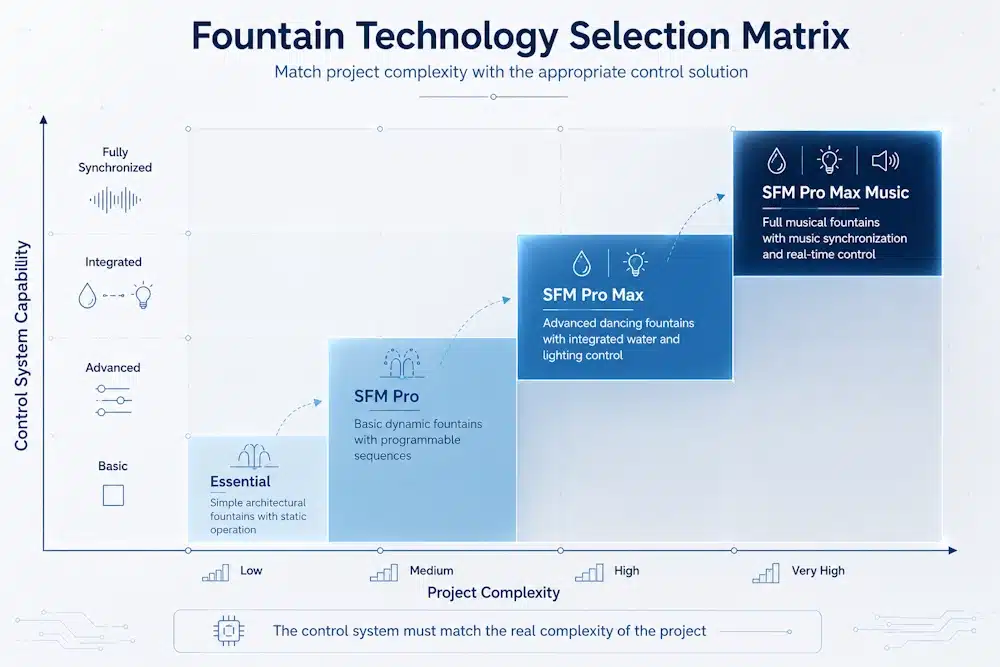
Not all installations require the same level of automation. For urban and classic architectural fountains, for essential dynamic capabilities, solutions such as our Essential Plus control technology These systems facilitate the control of multiple hydraulic circuits, the programming of diverse operational modes, and the integration of optional functionalities such as level control or anemometer-driven management. This type of system is particularly suitable for dynamic fountains of lower complexity, where the aim is to introduce water movement without the necessity of advanced programming.
Smart Fountain Manager Pro
When a project demands a higher degree of customization, the Smart Fountain Manager (SFM) family is deployed. The SFM Pro version is designed for dancing fountains without musical synchronization, enabling the management of multiple hydraulic circuits, adjustment of jet height via variable frequency drives, programming of advanced sequences, and monitoring of parameters such as water level or wind speed.
Smart Fountain Manager Pro Max
For more ambitious installations, SFM Pro Max expands control capabilities by incorporating advanced lighting management via DMX technology, customized programming of hydraulic and lighting sequences, remote control, and enhanced adaptability to diverse operational scenarios. This enables the water and lighting elements to function as a unified, coordinated system, capable of modifying their presentation based on the time of day, specific events, or pre-programmed schedules.
Smart Fountain Manager Pro Max Music
The most advanced level is achieved with SFM Pro Max Music, specifically designed for musical fountains and water shows. In this instance, the synchronization among water, light, and sound becomes the central element of the project. The system enables the creation and modification of choreographies, the programming of complete shows, and the coordination of all installation devices within a single timeline, ensuring that every water movement and lighting change occurs at the precisely scheduled moment.
The direct consequence of this evolution is that the water fountain transcends its role as a static hydraulic infrastructure, transforming into a dynamic system capable of adapting to its environment, optimizing resources, and delivering entirely distinct visual experiences from a single installation. This, precisely, is the distinguishing factor between a conventional architectural fountain and a true dancing fountain.
Light and Color: When Water Becomes a Spectacle
Lighting completely transforms the perception of a dancing fountainThe objective is not merely to render it visible, but rather to integrate it into a visual narrative capable of reinforcing the movement, depth, and rhythm of each scene.
In a classical architectural fountain, lighting primarily serves an accentuation function. However, in a dancing fountain, light is an active part of the spectacle and consequently becomes an element as integral as the water features themselves.
There are two principal approaches:
- Functional lighting: accentuates the water volume without altering its visual dynamics.
- Dynamic Lighting: synchronizes with the water movements to create immersive and dynamic experiences.
In this second scenario, coordination is essential. The intensity, color, and timing of activation must complement each hydraulic sequence to ensure a cohesive overall impression.
Furthermore, each type of aquatic effect interacts distinctly with illumination. Crystalline water jets exhibit high-definition reflection of light, whereas those with volumetric or atomized effects necessitate specific lighting strategies to ensure their visibility.
Therefore, the illumination of a dancing fountain should not be regarded as an accessory integrated solely at the project's conclusion, but rather as an intrinsic element of the design from its initial development phases.
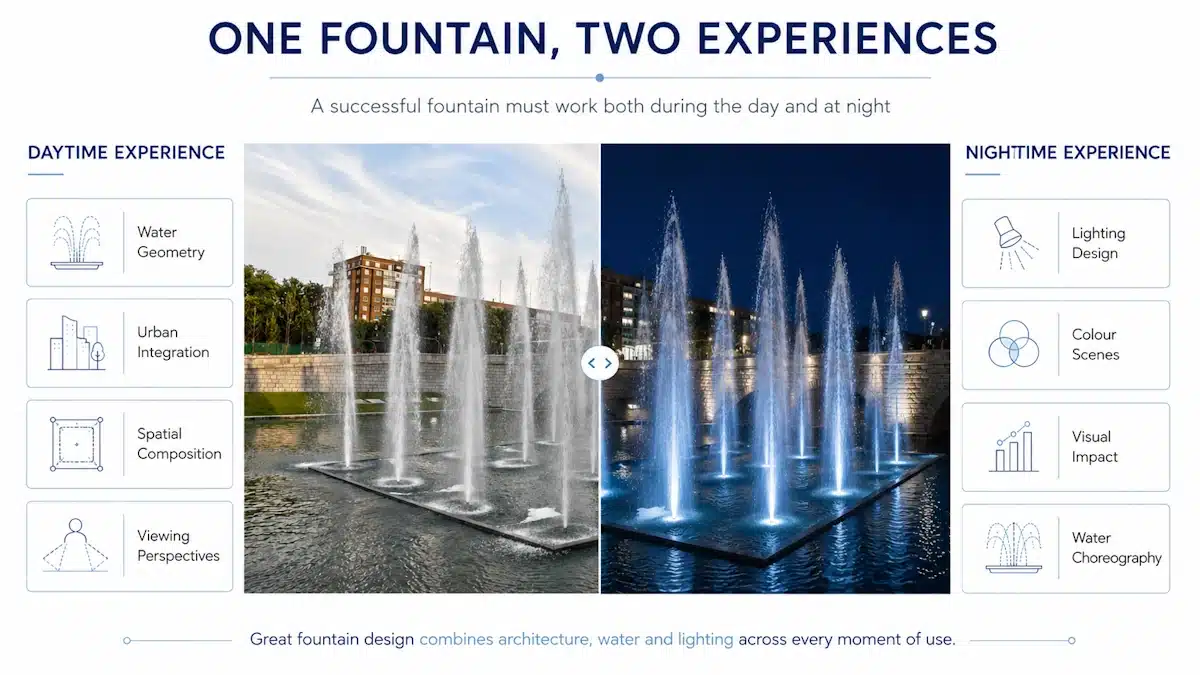
During the design phase, it is also pertinent to consider that a dancing fountain, in essence, provides two distinct experiences. During daylight hours, the perception is primarily shaped by the geometry of the jets, the dynamics of the water, the integration of materials, and the symbiotic relationship between the installation and its architectural context. The fountain is thus perceived as a tangible physical element within the urban landscape.
However, as night falls, illumination assumes a pivotal role, transforming the user's perception of the entire installation. The same hydraulic effects can evoke entirely different sensations when combined with color changes, lighting contrasts, and dynamic sequences. Consequently, a well-designed dancing fountain must operate cohesively during both daytime and nighttime hours.
Architecturally, this dictates that the project's evaluation must not be predicated solely on the nocturnal spectacle's grandeur. The design's inherent quality is also manifested in the installation's capacity for seamless visual integration within its environment during non-operational hours.
Common Pitfalls in Dynamic Fountain Design
Although each project entails specific requirements, there are common pitfalls that can jeopardize both the urban integration and the aesthetic outcome of a dynamic fountain.
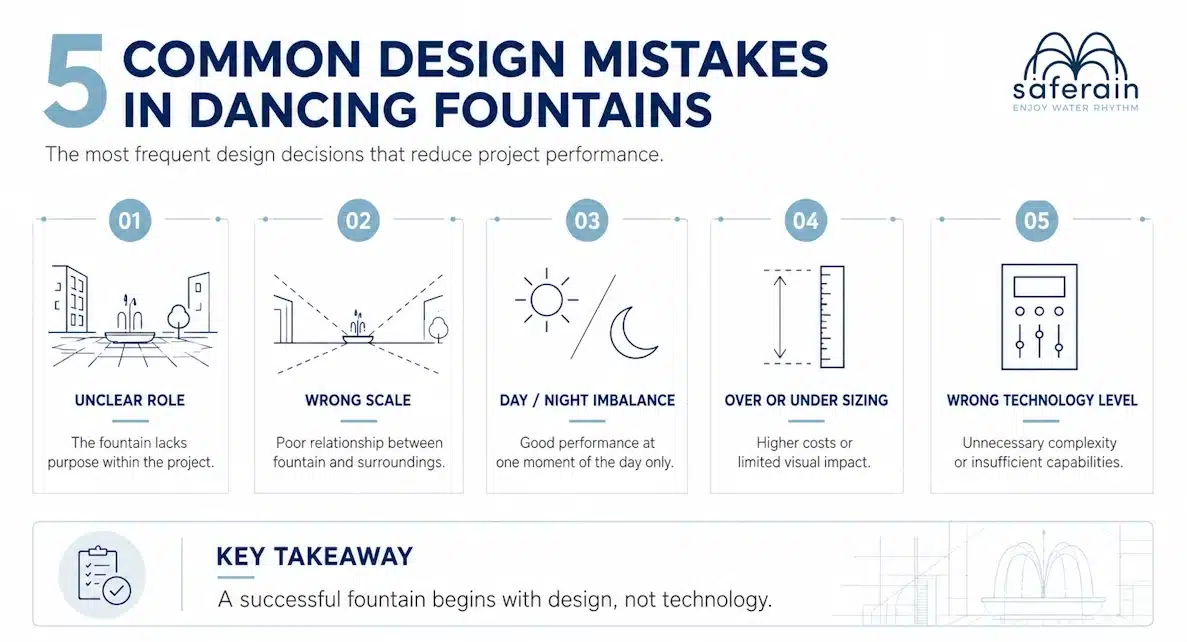
Defining the dynamic fountain prior to determining its role within the project.
A dancing fountain can serve as a complementary feature or become the primary focal point of a public square or park. If this decision is not integrated during the conceptual design phase, the overall design often loses coherence with the intended spatial objectives.
Disregard the scale and observation points
The height of the jets, the breadth of the compositions, and the visual intensity of the spectacle must correspond to the scale of the environment and the distance from which it will be observed. A well-designed dancing fountain is not necessarily the largest, but rather one that maintains a proportionate relationship with its context.
Design exclusively for the night-time effect.
A dancing fountain must offer value both day and night. Focusing the project exclusively on lighting and nocturnal spectacle often results in installations that diminish visual impact in the absence of an active scene.
Oversizing or undersizing the installation
Over-specifying a fountain's capacity increases costs and operational complexity. Conversely, an undersized system limits its ability to execute the intended sequences and constrains its future development.
Conflating technology with actual need
Not all dancing fountains necessitate the same degree of automation. Implementing advanced systems where they offer no added value introduces superfluous complexity, while deploying overly rudimentary solutions in demanding projects can considerably constrain the ultimate result.
Ultimately, most problems can be avoided when architecture, hydraulics, lighting, and control are conceived as parts of a single system from the outset of the design.
Conclusion: Control as a Differentiating Factor
When analyzing a dancing fountain, it is easy to focus on the water jets, lighting, or visual effects. However, a well-designed dancing fountain is much more than a hydraulic spectacle: it is a tool capable of providing identity to public spaces, generating memorable experiences, and reinforcing the character of an urban environment.
Unlike a conventional architectural fountain, a dancing fountain, a musical fountain, or an interactive fountain requires architecture, hydraulics, lighting, sensors, and automation systems to work in a coordinated manner to offer a coherent experience both day and night. Its success does not solely depend on the quality of the installed equipment, but on how all these elements are integrated within a common design strategy.
The main takeaway is that a dancing fountain should not be understood as a sum of independent fountain heads, pumps, luminaires, or control systems. On the contrary, it must be conceived as an integrated system where each element contributes to a shared objective: transforming water into a visual experience capable of interacting with the architecture and the surrounding space.
In this context, the control system plays a fundamental role. Solutions such as Smart Fountain Manager, in its various versions, allow for coordinating water, lighting, and programming to execute everything from simple dynamic scenes to complex water and music shows. However, technology alone does not guarantee project success.
Therefore, the most critical decisions are typically made during the conceptual phase, when defining the fountain's role within the space, how it will be perceived by users, and the desired experience to be generated. When these questions are correctly addressed, technology ceases to be an end in itself and becomes a tool serving the design.
Ultimately, the greater the project's ambition, the greater the need to integrate architecture, water, lighting, and control within a unified vision. And it is precisely this ability to coordinate all these elements that transforms an architectural fountain into a true dancing fountain capable of generating spectacle, urban identity, and lasting value for the public space.
No Comments