



Jul 02 How to make a dancing fountain

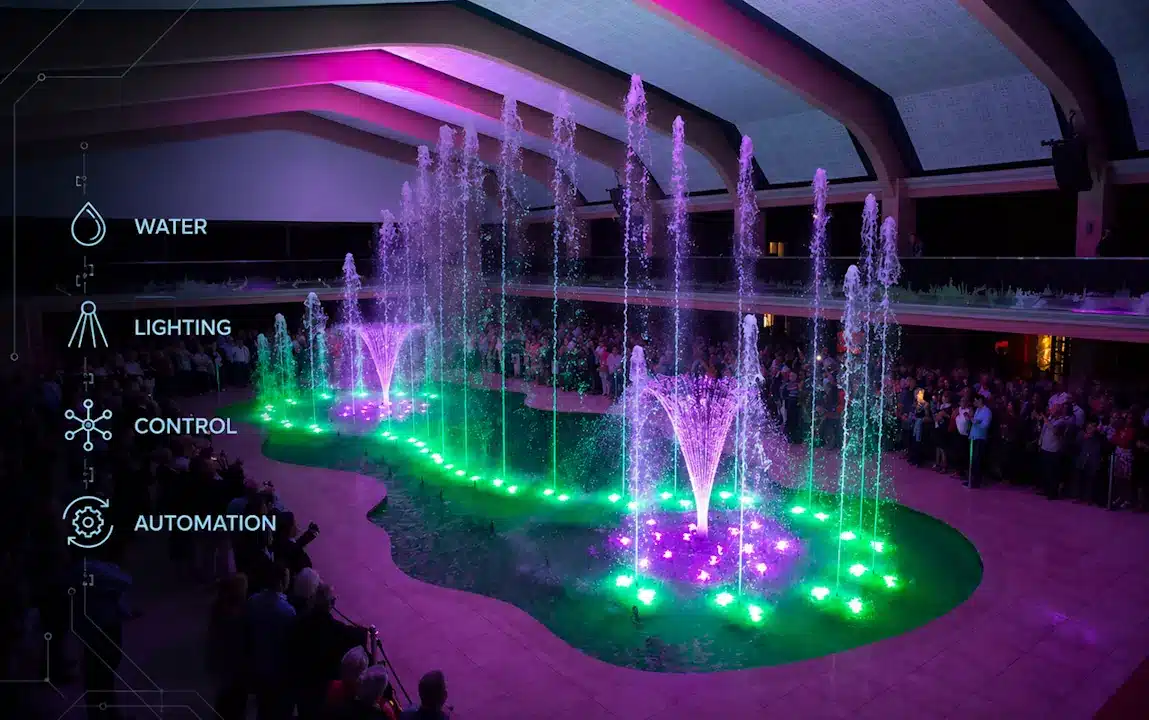
Dancing fountains represent one of the most advanced expressions of water architecture. They combine hydraulics, lighting, and control and programming systems to create water spectacles capable of transforming a plaza, a promenade, a tourist resort, or any public space into a memorable visual experience.
Although visitors perceive only water, light, and movement, behind every dancing fountain lies significant design work that determines the final outcome. Hydraulic planning, the selection of aquatic effects, spectacle simulation, and the control system are factors that influence both the aesthetic quality and the technical viability of the project.
Throughout this article, we will explore the main phases required to design and develop a dancing fountain, from the initial project definition to the programming of water choreographies.
When is it appropriate to design a dancing fountain?
Not all projects require a dancing fountain. This type of installation is typically the most suitable option when the objective is to create a landmark element within a public space, reinforce a location's identity, or generate a visual experience capable of attracting visitors both day and night.
In contrast to a traditional architectural fountain, a dancing fountain allows for the combination of water, light, and, in certain projects, music, to transform a plaza, urban park, promenade, or the surroundings of a unique building into a focal point with a strong experiential component.
Information to define before commencing the design
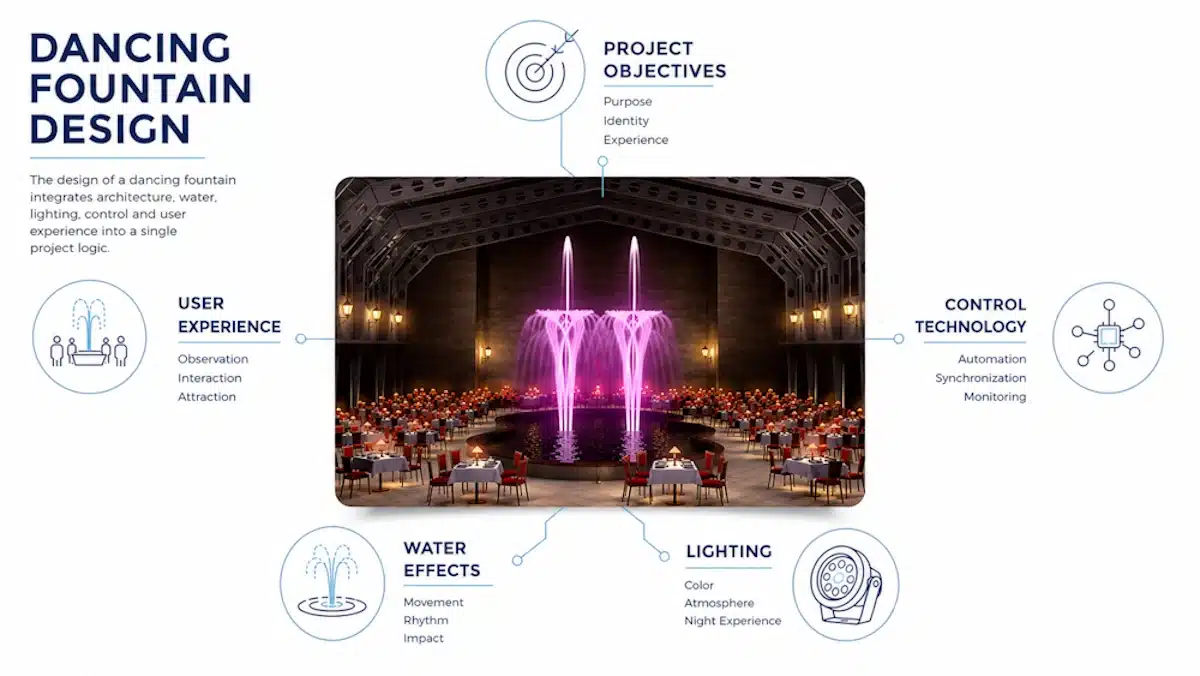
Before commencing the design of a dancing fountain, it is advisable for architects, engineering firms, and developers to define several aspects that will influence the subsequent project development:
- Approximate dimensions of the available space.
- Intended use of the environment and user profiles.
- The level of prominence the fountain will have within the architectural ensemble.
- The necessity or absence of music integration into the water show.
- Constraints related to civil works and the location of the technical room.
- Operational and maintenance requirements.
- Expected complexity level for the show.
Having this information available from the initial phases enables more informed decisions regarding water effects, the hydraulic system, lighting, and the control technology for the prospective dancing fountain.
Defining the Physical Setting of the Dancing Fountain
Every dancing fountain project commences well before the programming of its water shows. The initial step involves accurately defining the physical setting upon which the project will be developed.
During this phase, it is crucial to establish the type of experience intended for creation. A fountain designed to be an iconic urban landmark presents different requirements than an installation for a hotel, an urban park, or a commercial area. This decision will subsequently influence the layout of hydraulic components, the complexity of the choreographies, and the necessary control system.
Integration of the Dancing Fountain into the Architectural Project
A dancing fountain should not be perceived as an isolated element within a space, but rather as an integral component of the architectural project. In many instances, it functions as an element capable of structuring the environment, reinforcing visual axes, generating gathering points, and contributing to the identity of the location.
Its placement directly influences how users perceive the space. Consequently, during the initial design phases, it is advisable to analyze factors such as pedestrian pathways, primary observation points, its relationship with facades and distinctive environmental elements, the presence of vegetation or urban furniture, and the overall project scale.
The scale of the dancing fountain must maintain a coherent relationship with the dimensions of the available space and the role it is expected to play within the overall ensemble. While some fountains are conceived to become urban landmarks visible from a great distance, others aim to integrate more naturally into plazas, parks, or transitional spaces.
It is also advisable to analyze the user experience during both day and night, as well as from the various planned observation points. When architecture, lighting, and water are designed cohesively, the dancing fountain transcends its role as a decorative element to become an active component of the spatial experience.
Design of the Overall Composition
Once the project objectives are defined, the design of the fountain's visual composition commences, a phase that will influence both its aesthetic impact and future programming possibilities.
Key Aspects of the Composition
To achieve a balanced and coherent outcome, it is imperative to analyze various factors that directly influence the perception of the show:
- The overall geometry of the installation.
- The primary visual axes.
- The height and proportion of the water jets.
- The relationship among the various water effects.
- The integration of lighting within the dancing fountain scene.
Design for Day and Night
The arrangement of elements must be conceived to offer an engaging experience at all times. During the day, the emphasis is placed on the forms, volumes, and movements of the water; during the night, lighting assumes a crucial role in enhancing the expressiveness and visual impact of the ensemble.
Selection of Water Effects
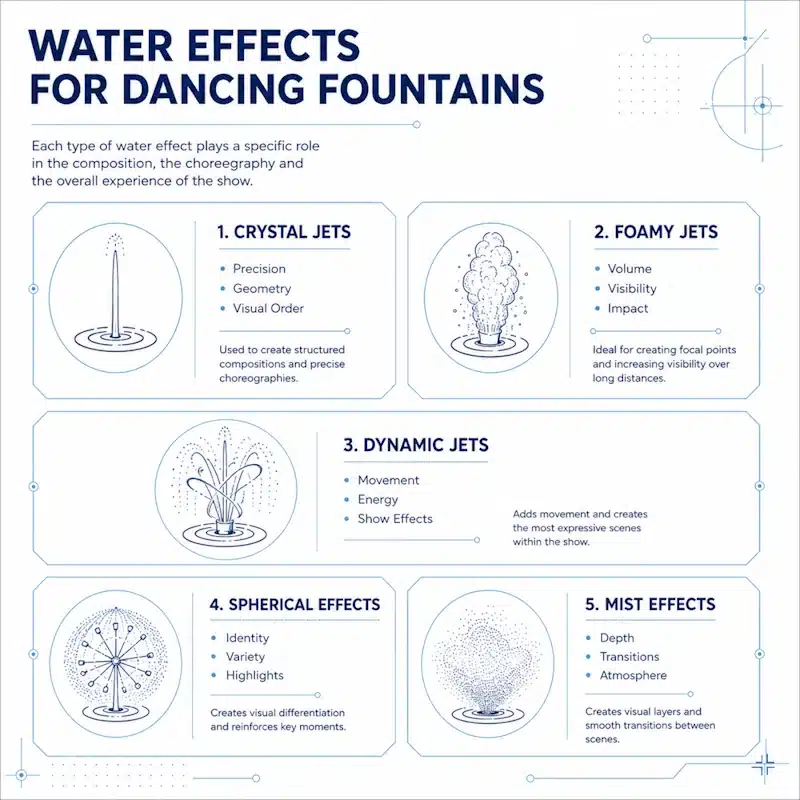
The selection of jets is one of the most critical aspects of a dancing fountain, as it largely dictates the creative potential of the project.
Depending on the design objectives, the composition may incorporate:
- Crystalline water jets: they form the foundation of many dancing fountains due to their capacity to generate clean, precise, and visually ordered water lines. They are particularly valuable for reinforcing visual axes, creating recognizable geometries, and developing choreographies where the synchronization and precision of movements play a pivotal role.
- Foaming water jets: they provide volume, presence, and high visibility, even in large or open spaces. They are a common solution when the objective is to enhance the visual impact of the dancing fountain, create focal points within the composition, or ensure clear perception of the show from long distances.
- Dynamic or Dancing Water Effects: These integrate movement within the water jet itself, enabling the creation of changing trajectories, rotations, oscillations, or continuous motion effects. Their primary contribution to a dancing fountain is to introduce a level of dynamism difficult to achieve with other types of fountain heads, thereby enhancing the sense of rhythm, energy, and spectacle of the entire display. They are particularly effective for creating focal scenes, reinforcing high-intensity moments within the choreography, or imparting a more theatrical and expressive character to the aquatic show.
- Atomizations: These generate light and dynamic water mists capable of adding depth and a sense of movement to the overall display. They are typically employed to enrich transitions between scenes, smooth out rhythm changes, or create immersive atmospheres that enhance the visual richness of the spectacle.
- Spherical Water Jets: These allow for the introduction of unique forms that break the repetition of other water effects and add variety to the composition. They are particularly useful for emphasizing specific moments within the choreography or for reinforcing the distinctive character of certain scenes within the dancing fountain.
Pumps and Hydraulic System
The definition of the hydraulic system constitutes one of the key phases for any dancing fountain, as it dictates both its hydraulic performance and the scenic possibilities it can offer during the show.
Elements Defining the Hydraulic System
To design an efficient and versatile dancing fountain, it is necessary to define several fundamental aspects:
- The water pumps to be utilized (submersible or dry).
- The hydraulic distribution of the various circuits.
- The groups of water effects that each pump will supply.
- The power required to ensure the correct operation of each aquatic effect.
The selection and configuration of these components will directly influence the dancing fountain's ability to generate precise and synchronized movements, transitions, and visual variations.
Selection of Pump Power
Once the pump type —submersible or dry— has been defined and the water effects for the dancing fountain have been selected, it is necessary to determine the appropriate power for each pump. This selection will be determined by the pressure and flow rate data that must be supplied to the various hydraulic effects. To achieve this, consulting the technical specifications corresponding to each selected component is essential.
Solenoid Valves and Individual Effect Control
The definition of the solenoid valves constitutes another fundamental aspect of a dancing fountain's hydraulic system. It is necessary to determine which water effects will be controlled by solenoid valves, as this decision directly influences the interaction capability of each jet and, consequently, the overall dynamism of the spectacle.
Although the most common solution in a dancing fountain involves assigning one solenoid valve to each water effect to maximize individual control, in certain projects, this functionality can also be achieved through groups of submersible pumps, provided that the hydraulic design and project objectives allow for it.
Dynamic Control of Jets
In projects demanding greater expressiveness, frequency converters capable of dynamically altering the height of the water jets can be incorporated. This enables the dancing fountain to create more fluid sequences, enhance the sense of movement, and increase the overall dynamism of the choreography.
Integrated lighting in the dancing fountain from the initial design phase
In a dancing fountain, lighting plays a fundamental role in enhancing water effects and reinforcing the visual impact of the spectacle. Therefore, its design must be addressed from the initial project phases, in coordination with the other hydraulic and control elements.
Selection of lighting technology
Lighting is an essential element in a dancing fountain, as it not only highlights water effects at night but also actively participates in the spectacle. For this reason, its design must be considered from the initial project phases and in coordination with the other hydraulic and control elements.
Currently, modern control technologies enable centralizing the operational management of the dancing fountain's functionality, optimizing daily operation, and facilitating maintenance tasks through remote monitoring and control tools.
Once the spatial composition, water effects, hydraulic system, and lighting of the dancing fountain have been defined, the next step involves validating the project through a three-dimensional simulation to verify its visual and technical feasibility before commencing manufacturing.
3D dancing water fountain animation
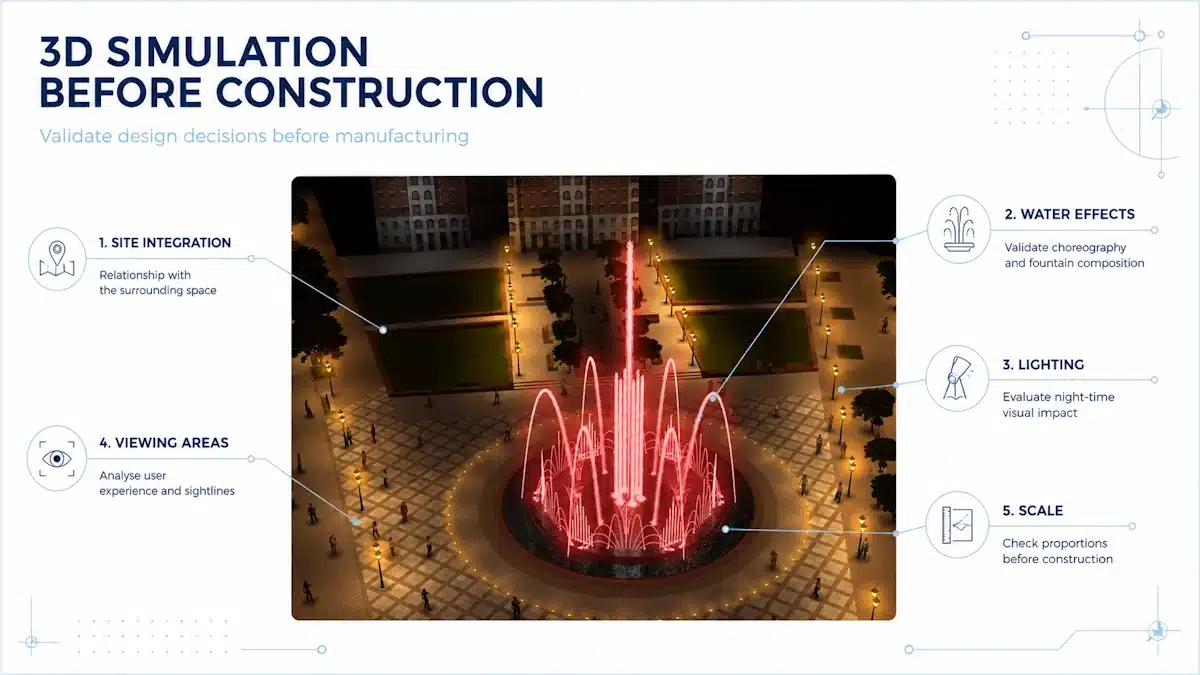
Once the conceptual design of the installation is defined, one of the most crucial project phases begins: the three-dimensional simulation of the fountain. The 3D simulation of the dancing fountain allows for a realistic representation of how the various water effects, lighting, and movement will behave before manufacturing or construction commences.
This phase has become a fundamental tool from both a technical and commercial perspective. Three-dimensional models help validate the proposal and allow for visualization of the final outcome before any investment is made.
Advantages of preliminary simulation
The 3D animation of a dancing fountain allows for:
- Verifying the overall design composition.
- Validating the heights of the water jets.
- Analyzing the interaction between water and lighting.
- Adjusting the various aquatic effects.
- Evaluate potential enhancements prior to manufacturing.
- Visually present the project to clients, architects, and public administrations.
Furthermore, it facilitates decision-making and significantly reduces subsequent modifications during the execution phase.
3D rendering as a project validation tool
For architects, engineering firms, and developers, 3D simulation of a dancing fountain extends far beyond a mere attractive visual representation. It allows for verification of whether the water jet proportions are appropriate for the space's scale, analysis of the interaction between the dancing fountain and its architectural surroundings, and validation of the visual impact the display will have, both day and night.
Pre-visualization also aids in detecting potential adjustments in the arrangement of water effects, lighting, or observation points before commencing manufacturing and construction. This contributes to reducing uncertainties, enhancing the project's technical definition, and ensuring that the constructed dancing fountain faithfully aligns with the vision conceived during design.
Design of the dancing fountain control system
If hydraulic elements constitute the body of the dancing fountain, the control system represents its brain. Modern dancing fountains require /tecnologia-fuentes/fuentes-dinamicas-musicales/control technologies capable of simultaneously coordinating all elements involved in the aquatic display. SafeRain emphasizes the importance of the control system as the element that defines the behavior of a dynamic fountain.
What a modern system controls
The control system coordinates and manages elements such as:
- Water jets.
- Solenoid valves.
- Submersible or dry water pumps.
- Variable frequency drives.
- Lighting systems.
- Programmed scenes.
- Musical sequences.
The objective is to ensure that each element operates precisely at the intended moment to achieve perfect synchronization.
Complexity levels of a dancing fountain and control architecture
Not all dancing fountains require the same level of control technology. As project complexity increases, so does the need to coordinate a greater number of water effects, hydraulic equipment, lighting scenes, and programmed sequences. For this reason, the control technology must adapt to the desired level of dynamism, customization, and scenic capability.
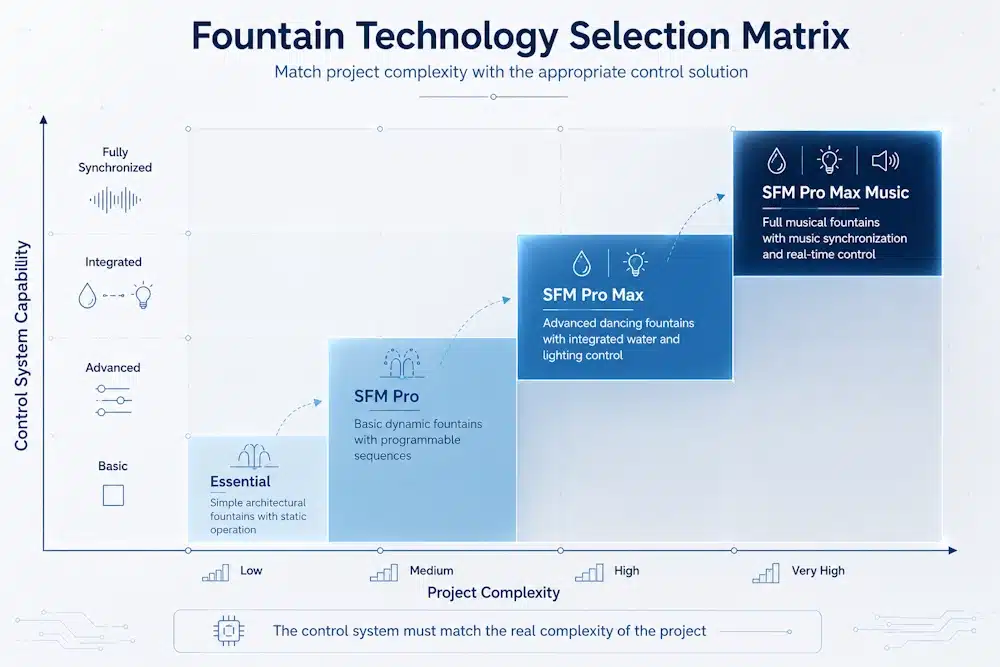
The following matrix illustrates how control requirements evolve from a medium-complexity dynamic fountain to a musical fountain capable of synchronizing water, lighting, and music within a single choreography.
This classification does not solely pertain to the size of the dancing fountain but primarily to the experience intended to be created. A dynamic fountain can offer highly attractive water and lighting movements with a relatively simple control architecture. However, when the project incorporates a greater number of effects, complex scenes, or musical shows, it becomes essential to have platforms capable of simultaneously managing dozens of signals and maintaining precise coordination among all elements of the display. The selection of the control system must therefore be understood as a strategic decision that will determine the flexibility, programming capability, and future evolution possibilities of the dancing fountain.
Control technologies adapted to each complexity level
As the complexity of a dancing fountain increases, so do the demands on the control system. The coordination of pumps, solenoid valves, lighting, and programmed sequences requires a platform capable of managing each element precisely and synchronously.
To address varying levels of complexity, SafeRain has developed the Smart Fountain Manager family of controllers, comprising different versions tailored to the requirements of each project.
- Smart Fountain Manager Pro: The SFM Pro version is designed for dynamic fountains and medium-complexity dancing fountains that require a high level of control over water effects and lighting. It enables the coordination of various installation elements from a single platform, facilitating the creation of programmed sequences and the daily management of the fountain.
- Smart Fountain Manager Pro Max: When the project incorporates a greater number of water effects, hydraulic circuits, and lighting elements, the Pro Max version provides superior control capability. This solution is particularly suitable for large-scale dancing fountains where it is necessary to manage a high number of signals and scenes while maintaining precise synchronization among all components of the display.
- Smart Fountain Manager Pro Max Music: The Pro Max Music version has been designed for musical fountains and aquatic shows where the synchronization between water, lighting, and music plays a starring role. Thanks to its ability to simultaneously manage multiple control channels, it enables the development of advanced choreographies in which every water movement and color change is integrated into a perfectly coordinated audiovisual experience.
Centralized management
The evolution of dancing fountains has been accompanied by increasingly advanced control systems, capable of integrating the management of water effects, lighting, hydraulic equipment, and programmed sequences into a single platform. This centralization allows for simplifying the daily operation of the installation and ensuring precise coordination among all elements involved in the display.
In addition to facilitating the programming of complex scenes and choreographies, current management systems enable real-time monitoring of the dancing fountain's status, optimizing maintenance tasks, and expediting the detection of potential issues. Consequently, it is possible to enhance the installation's reliability, reduce intervention times, and ensure more efficient operation throughout its entire service life.
Programming and choreography of the dancing fountain
The final phase involves transforming all installed components into a coordinated water show. Programming a dancing fountain entails designing visual sequences where water, lighting, and music synergistically combine to deliver a cohesive experience.
- Music Selection: The chosen musical composition dictates the overall rhythm of the water show. Pieces featuring variations in intensity, strategic pauses, and tempo changes provide enhanced opportunities for crafting dynamic and visually captivating sequences.
- Scene Design: Following music selection, the narrative structure of the show is developed.
- Each scene defines the following parameters:
- Which water jets are activated.
- The height they achieve.
- The lighting scheme employed.
- The timing of each transition.
Synchronization of water and lighting
The precise coordination between water and light significantly influences the visual impact of a dancing fountain. Programming must ensure that color transitions, intensity modulations, and water movements are executed with perfect synchronization.
Final tests and adjustments
Upon completion of programming, various operational tests are conducted to verify the actual performance of all components. During this stage, response times, sequences, operational heights, and visual effects are meticulously adjusted to achieve the desired outcome.
The final commissioning signifies the culmination of a process that integrates design, engineering, technology, and creativity to transform water into a truly authentic show.
Are you considering incorporating a dancing fountain into your project?
The design phase for a dancing fountain is critical to ensure the installation achieves its aesthetic, technical, and operational objectives. Precisely defining the water effects, lighting, hydraulic system, and control architecture will yield a viable solution tailored to the specific requirements of the dancing fountain project.
No Comments