



June 18 The control system in dynamic fountains: the 'brain' that defines the project
When discussing an architectural fountain, it is common for the project's focus to gravitate towards its visible aspects: the composition, the water jets, its integration with public spaces, nocturnal illumination, or the overall experience it is intended to create. However, in practical application, a water fountain is not solely defined by its aesthetic form but critically by its operational performance.
Does it automatically turn on and off daily, without manual intervention? Does it offer protection against wind, low water levels, or electrical failures? Can it smoothly vary jet heights and sequences? Does the lighting synchronize with the water, or does it operate independently? Do operating personnel comprehend the cause of an alarm? All these questions hinge on a critical component that, if considered secondary or deferred to the final stages, frequently becomes the root cause of operational issues: the control system or technology.
In this article, we will define what constitutes the control of an architectural fountain – irrespective of whether it is a classic architectural fountain or a dancing fountain – detailing the functions it encompasses and explaining why it fundamentally dictates the actual operational performance of the installation from the initial design phase. The objective is to empower technicians to make more proactive and sound decisions, thereby preventing cost overruns, performance constraints, and, critically, safety hazards.
Context: architectural fountains requiring autonomous, secure, and coordinated operation
Modern architectural fountains rarely have a dedicated 'operator'. In roundabouts, squares, parks, or commercial spaces, the fountain is expected to:
- Automatically start and stop at the scheduled times.
- Ensure consistent and reproducible performance (so that show 1 maintains an identical appearance from day 1 to day 100).
- Protect yourself from adverse conditions without relying on human intervention.
- Integrate water and light (and, if applicable, music) in a way that lives up to the design intent.
Compounding this is a crucial reality: the coexistence of water and electricity, frequently within public environments, where the margin for error is exceptionally narrow. While an architectural fountain can significantly enhance urban value, its viability is undermined if it splashes beyond its designated perimeter during windy conditions, generates excessive noise outside operational hours, or becomes unduly complex to operate.
In other words: performance—autonomy, safety, coordination, and ease of operation—is not a “bonus.” It is part of the design.
The primary challenge lies in treating control as a 'secondary layer' or deferring its consideration until the final stages.
A recurring pattern observed in numerous projects is that control systems are addressed belatedly, typically when hydraulics, illumination, civil engineering, and associated equipment are already substantially finalized. At this juncture, control ceases to be a strategic tool and instead becomes a challenging integration.
The typical outcome is not merely a more expensive control panel. It leads to cost overruns and project delays stemming from last-minute modifications, limitations in achieving the intended hydraulic effects, or, worse still, an architectural fountain that operates with inherent risks or exhibits erratic performance.
Here are some real-life scenarios that can be avoided if monitoring is planned from the start:
- Equipment that breaks down within a few months due to a lack of sensors and protective features.
- Serious electrical hazards due to improperly designed or incomplete protective measures.
- Fountain to perform the choreographed routines as envisioned due to a lack of outlets, capacity, or lighting integration.
- Complaints about noise, inappropriate hours, or spills outside the glass.
- Safety issues with dry deck fountains interactivedry deck fountains due to the lack of specific control logic, sensors, or an accessible emergency stop.
The fundamental principle is clear: deferring control inevitably postpones operational behavior. And this behavior constitutes the true function of the architectural fountain.
Key Concepts: Defining Control and Its Function as the Fountain's 'Brain'
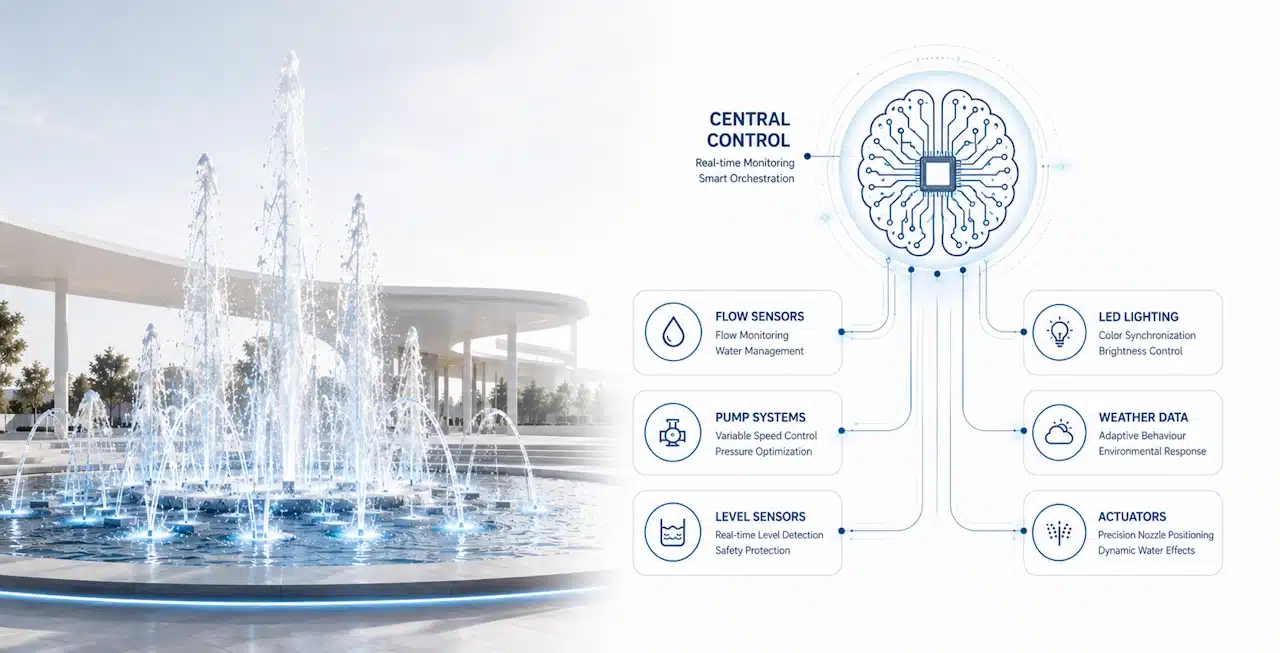
An automated fountain control system can be practically defined as the combination of hardware and software that enables the fountain to operate as a coordinated system. It can be referred to as the 'brain' because it makes real-time decisions:
- Reads sensors.
- Executes logic and sequences.
- Turn on the water pumps, valves, and lights.
- Manage schedules and modes.
- It monitors events, generates alerts, and facilitates operations.
What functions does an automated control technology encompass?
At the project level, architectural fountain control typically encompasses these essential functions:
- Scheduled and Safe Power On and Off
- Set the operating schedules for pumps and lights.
- It executes start-up and shutdown sequences that prevent water hammer and current surges.
- Equipment Protection and Personal Safety
- It incorporates sensors such as level probes and anemometers.
- It stops the pumps when the level is low (to prevent dry running) and can activate automatic refilling.
- Reduce the spray height or turn off the fountain strong winds to prevent water from splashing outside the perimeter.
- It includes alarms that help with diagnostics and maintenance.
- Smart Lighting Management
- From basic on/off control to coordinated changes in LED color and brightness.
- It allows water and electricity to function as a single system.
- Modulation of Water Movement
- Variation in the height and shape of water jets (using frequency converters and/or solenoid valves).
- Dynamic sequences and water choreography.
- Adaptation to the environment and context
- Annual schedule of major events for the region or country.
- Adjustment based on the astronomical clock (sunrise/sunset).
- Response to sensors (wind, water level, presence in interactive fountains, etc.).
- Ease of use and maintenance
- Human-Machine Interface (HMI) for viewing statuses and alarms and taking action.
- Monitor events that enable a shift from reactive to preventive maintenance.
- Option for remote monitoring or notifications.
Streamlined Architecture: Standard Components
Without getting into specific brands or solutions, the typical control architecture includes:
- Electrical Control Panel: an enclosure housing protective devices (circuit breakers, residual current devices), contactors, power supplies, variable frequency drives, PLCs, and occasionally, the HMI.
- PLC (Programmable Logic Controller): executes logic, reads sensors, and governs actuators. It typically forms the core of critical functions.
- I/O (Inputs and Outputs): channels through which the PLC receives information (e.g., from sensors) and controls outputs (e.g., pumps, valves, lights).
- Variable Frequency Drives (VFDs): enable smooth pump modulation to regulate water jet heights and protect equipment.
- Operation and Maintenance Console (HMI): a touch screen or graphic panel for operational control and supervision.
- Choreography/Show Software: for advanced sequences (especially those involving music), a timeline is utilized to program synchronized events.
- Protocols and communications: for integrating lighting (e.g., DMX512), dimmers, and, in some cases, remote access.
This configuration delineates the scope of capabilities and their inherent limitations. Consequently, the control system is not merely an accessory; rather, it constitutes the essential framework for realizing the design's intent.
Practical Development: Control-Dependent Decisions (and their Impact on the Project)
This is the key point for a prescriber: understanding which project decisions are “blocked” or “enabled” depending on the control.
Typology: Not all water fountains have identical requirements.
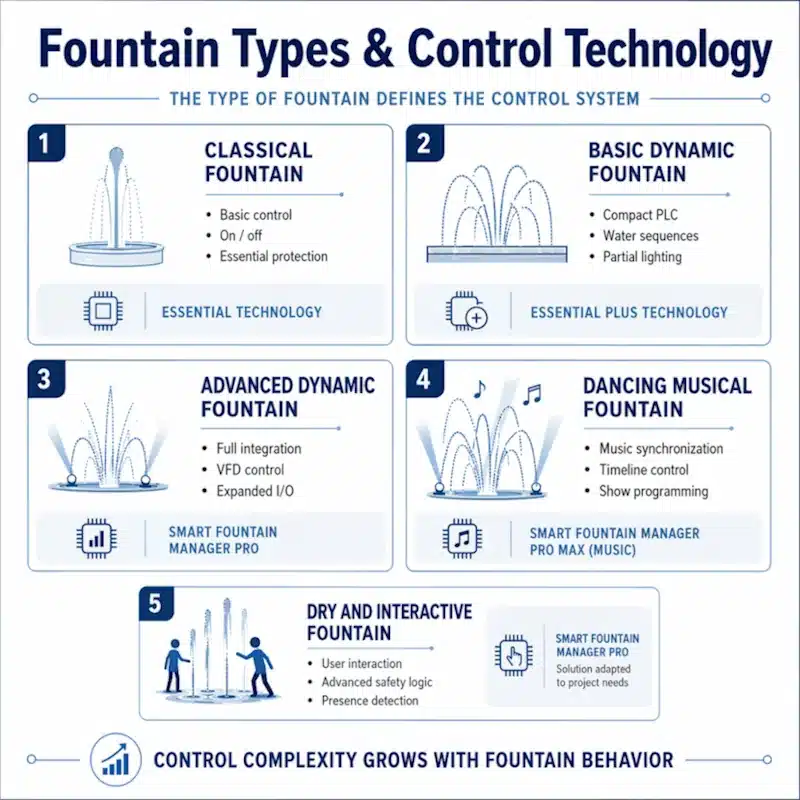
The guide categorizes types based on complexity and, accordingly, control requirements:
- Architectural fountains (non-dynamic): basic controls (timer, on/off, essential safety features, simple lighting).
- Basic dynamic fountains: Compact PLC for water sequencing; often partial or independent lighting; weekly scheduling.
- Advanced dynamic fountains: complete integration of water and light, enhanced I/O capabilities, variable frequency drives, choreography software; with remote control functionality.
- Dancing Fountains: This system builds upon the preceding level by integrating audio synchronization, timeline-based choreographies, and, in certain instances, a music analyzer.
- Dry deck and interactive fountains: These systems can operate in static, dynamic, or musical modes, but they inherently require specialized logic and robust safety protocols designed for public interaction.
The initial practical decision involves defining the precise typology sought, as this directly influences the operational control range.
Hydraulics and Control: How Degrees of Freedom Are Distributed
Two projects may have the same number of nozzles and yet behave very differently. The difference usually lies in:
- How nozzles are grouped by hydraulic circuit (one pump for multiple nozzles vs. more independent circuits).
- If valves are added to activate effects by group.
- If frequency converters are installed for pitch modulation.
When multiple jets are powered by a single pump, the control system will manage them as a unified group, resulting in synchronized operation. Achieving true independent operation necessitates a hydraulic architecture designed for autonomy, complemented by a control system equipped with the requisite outputs, logic, and programming capabilities to govern each jet individually.
Lighting and control: determine the level of integration (prior to luminaire selection)
The document highlights a distinction that is easily overlooked: partial control versus total control of lighting.
- Under partial control, an external controller can execute color cycles independently of the water flow.
- Under total control, the choreography dictates the color and intensity of each luminaire (or group thereof) at every instant.
The difference is not merely cosmetic: it is the distinction between decorative lighting and choreographed lighting. This decision, furthermore, dictates:
- Programming capabilities.
- The number of channels to consider.
- The complexity of implementation.
- End-customer expectations.
Furthermore, the selection between RGB and RGBW impacts channel dimensioning and scene design. RGBW introduces an additional channel per fixture, offering expanded chromatic possibilities and necessitating more comprehensive planning.
User Interface and Operation: Day-to-Day Use Matters
An architectural dancingfountain can be well-designed and still fail to function properly if:
- The operation and maintenance console (HMI) is confusing.
- The alarms are unclear.
- There are no clear records.
- Highly specialized personnel are required.
The control of the architectural fountain must encompass actual operation: maintenance, cleaning, test modes, alarms, and, where applicable, remote monitoring.
Scalability: incorporating future capacity is designing for long-term viability
Under-provisioning the PLC, I/O, or control capacity can severely restrict a fountain's growth potential, precluding the integration of additional jets, lights, new scenes, or sensors. Conversely, maintaining documented spare capacity enables future system enhancements without necessitating a complete control panel replacement.
Typical Scenarios: Preventable Failures, Limitations, and Safety Concerns
This guide addresses specific challenges that frequently emerge when control systems are specified belatedly or inadequately dimensioned. It is beneficial to contextualize these into identifiable project scenarios.
The architectural fountain is not performing as we had designed.
Occasionally, a project may propose a water and light choreography that the control panel cannot execute, either due to insufficient outputs, inadequate lighting levels, or the lack of provisioned variable frequency drives for effect modulation. Consequently, the resulting display may appear static or be difficult to program. To prevent this, it is advisable to develop a 3D rendered video that demonstrates the synchronized sequence of water, light, and music, providing a clear visual reference during the design phase of the dancing or musical fountain.
“It operates, but erratically” (in dancing fountains)
In dancing fountains featuring aquatic spectacles, an inadequately specified control panel (e.g., insufficient capacity, outdated controllers) can lead to erratic operation, including desynchronized lighting, unstable sequences, or challenges in consistently executing the show.
“Premature failures” attributable to the absence of adequate protective measures and control logic
Without key sensors or protective measures, submersible pumps are susceptible to failure caused by dry running, overloads, or sudden starts/stops. Variable frequency drives not only enhance operational flexibility but also facilitate smooth acceleration/deceleration ramps, thereby mitigating water hammer and electrical stress.
Complaints concerning noise levels, operational schedules, or overspray beyond the fountain basin.
A water fountain that fails to dynamically adapt to prevailing wind conditions, adhere to programmed operational schedules, or adjust its performance parameters to the surrounding environment will inevitably generate urban disruption. The implementation of robust control systems enables precise programming and real-time reactive capabilities; this is not a mere detail, but the fundamental distinction between achieving urban acceptance and fostering public discord.
dry deck fountains: Safety and Interaction Are Non-Negotiable
In dry or interactive fountains, the public interacts directly with the system. Without dedicated control logic, appropriate sensors, and a readily accessible emergency stop, the risk profile is significantly elevated. Therefore, the control system must incorporate fail-safe operating modes and ensure rapid response to actual operational conditions.
Common Mistakes and Best Practices (for Designing Controls from the Start)
The following lists common control architecture design errors and their alternatives in the form of best practices.
Mistakes That Often Cost Money (and Reputation)
- Underestimating the complexity of the required control – Consequence: functions that don't work, premature failures, jets or lights that don't behave as expected.
- Failure to coordinate controls with plumbing and lighting – Consequence: incompatibilities between the design and what can be controlled; need for additional construction work or equipment.
- Sizing the PLC and I/O to the limit – Consequence: cannot be expanded; replacement is costly.
- Failure to select the appropriate cables and connectors – Consequences: Possible interference, damage to equipment caused by water leakage
- Failure to define communications and topology in the design phase – Consequence: integration problems, latency, or loss of control.
- Incorrectly separating power and control in the control panel – Consequence: interference, unintended tripping, communication failures.
- Underestimating the heat dissipation of the enclosure – Consequence: shutdowns due to overheating, shorter equipment lifespan.
- Failure to define ramps and startup sequences – Consequence: water hammer, power surges, noise.
- Failing to properly plan lighting controls and their level of integration – Consequence: unmet expectations and costly rescheduling.
- Operation and maintenance (HM) console designed for engineering rather than operations – Consequence: human errors, reliance on specialized personnel.
- Failure to integrate key sensors (level, wind, etc.) and their associated logic – Consequence: safety risks, public complaints, and damage.
Best Practices That Make Life Easier
- Involve control technology specialists early on—not to “complicate” things, but to align capabilities with objectives.
- Design controls, hydraulics, and lighting in an integrated manner: a single, coherent system, not separate components that are simply pieced together at the end.
- Define the level of lighting control for the project: decide between “partial vs. full” and size the system accordingly.
- Define a strategy for alarms, logs, and user roles: clear operation, preventive maintenance.
- Provide remote access when the situation warrants it: this reduces support costs and response times.
- Require complete documentation and training: diagrams, guidelines, backups, manuals, and a deployment and training plan.
Designing the control system for an architectural fountain is to define its actual operational behavior.
In an architectural fountain, water and light constitute the language. However, control serves as the grammar that ensures this language is coherent, secure, and repeatable.
Effective control of an architectural fountain or a dancing fountain extends beyond mere activation and deactivation. It dictates its startup sequence, protection mechanisms, environmental adaptability, coordination of water and light (and music, if applicable), operational procedures, and maintenance protocols. Ultimately, it defines the end-user experience.
Therefore, if there is one principle to establish from the project's inception, it is this: do not defer the design of the control system until the final stages. Delaying its design inherently delays the definition of the system's operational behavior. And it is this behavior—encompassing autonomy, safety, and the quality of the spectacle—that truly transforms a fountain into a robust and viable project.
Quick Checklist (for control system review during the design phase)
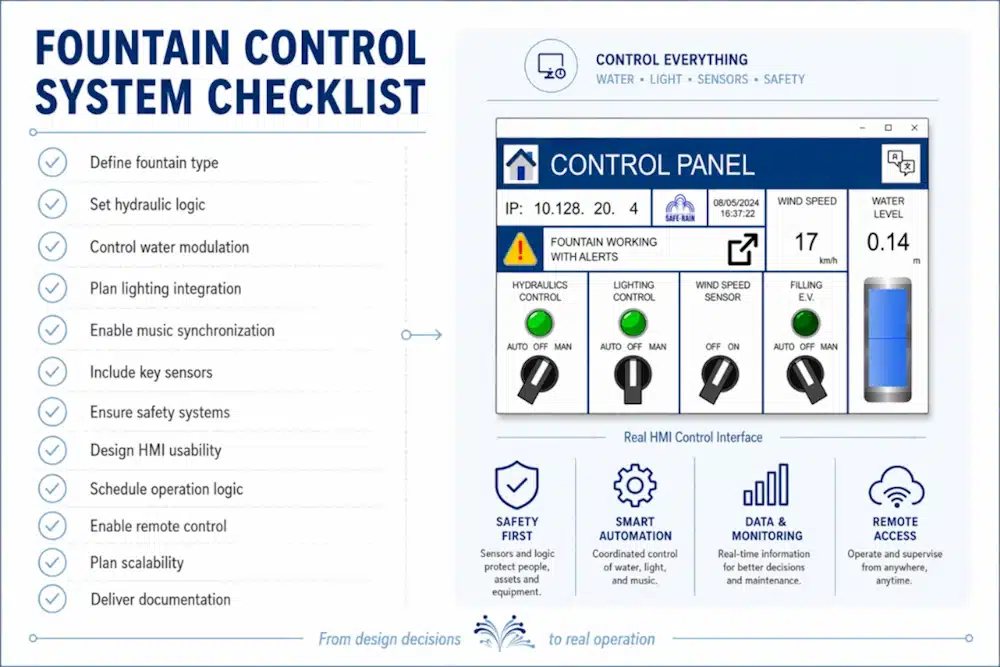
- Is the type (static, dynamic, musical, walkable) clearly defined?
- Have the number of hydraulic circuits and the grouping/independence logic been defined?
- Is speed control (variable-speed drives) required, or is on/off sufficient?
- Have the type of lighting (white, RGB, RGBW), the number of lighting groups, and the level of control (partial vs. full) been planned?
- If applicable, has music synchronization been planned (software, timeline, analyzer)?
- Does the project include the essential sensors (level, wind, temperature if applicable, and presence sensors for interactive systems) and the twilight switch?
- Are emergency shutdowns, electrical protections, and alarm response logic included?
- Is the operation and maintenance console (HMI) functional (clear alarms, user roles, understandable menus)?
- Has a schedule been planned, and, if applicable, an astronomical clock?
- Is a remote control needed, and is it included?
- Does the design allow for future expansion (I/O, control capacity, cabinet space)?
- Will documentation and training be provided to the end user?
No Comments