




25 Jun Design of dry deck fountain
 - dry Fountains are currently very popular and you can find this type of interactive play fountains in a vast array of locations, from public squares and parks to shopping centers, where they provide interactivity for young children. A common factor frequently found in these fountains is that they seek to bring rhythm and movement to the water , turning the space around them into an attractive place for tourism.
The infrastructure and installation that dry deck fountains need is complex, and, therefore, in this article, and using as our Waterboy Kit as an example, we will try to summarize the most common elements in these kinds of projects. The Waterboy can be installed individually or collectively, either in rows or arrays or in geometrical shapes that the dry fountain design needs.
Dry deck fountains are characterized by having a hidden structure, below our feet, which means that we can have an architectural fountain with their respective water games, in the same space as a dry environment, when the fountain is not running, which we can use for other events . For this, we use a concrete channel, a structure that contains the water for the proper operation of the architectural fountain. This water returns to the tank through a grid placed around it, and through the dry fountain kit, which includes a grill for return and drainage to the tank. The use of a system for filtering and purification of the water is essential for maintenance of the water.
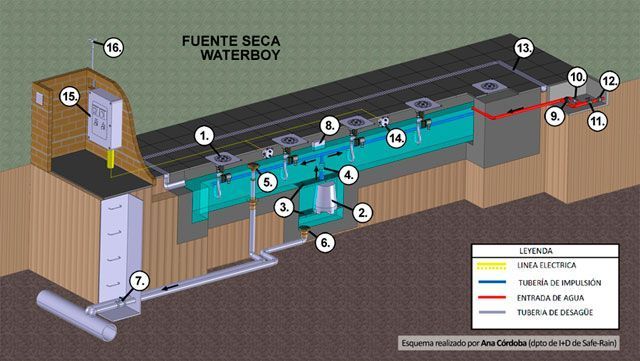
We have simulated a real dry fountain installation in the following image, bringing together the components that are most frequently used. Take into account that dry fountains are not limited to the elements pictured, nor do all dry fountains include these elements, since each project has its own special features.
1. The Waterboy is our installation kit for dry fountains, made of stainless steel, with White or RGB LED lighting, controlled by an electrical panel (15) to perform water and light games. There are three models of Waterboy:


- Constant water output and lighting control, with this model the water output is free and the RGB LED lighting is controllable with the electrical panel (15).
- Water and lighting control, in this case, we control the water output with solenoid valves, and the lighting is, similar to the previous model, controlled from the electrical panel (15).
- Control of water output and height, and lighting, with the inverter we can control the height of the water jets and the LED RGB lighting.
2.  The choice of a submersible or horizontal pump depends on the designer and the availability of space for construction of the casing to house the pump, electrical panels, etc. With this pump, water is driven to the Waterboy through the discharge pipe. The first design depicts a submersible pump, and the second depicts a horizontal pump, in order to demonstrate both options.
A horizontal pump can also be used in this installation, using a foot valve (a), a key (b) to regulate the pump input flow, a key (c) to regulate the output flow, and a retention valve (d) in the discharge pipe.
 3. Grid or mesh, used as a pre-filter to prevent dirt particles from being sucked into the pump.
 4. Pump flow regulation valve, with this valve, we can regulate the desired height of the water jets in the dry fountain.
 5. overflow, lets the water output that surpasses the desired level into the dry fountain's tank. For example, it is very necessary in the case of heavy rains or when there are failures in the water input.
 6. Base outlet, serves to empty the dry fountain's tank.
 7. Dry fountain drain valve, this valve allows for emptying the dry fountain's tank through the base outlet (6).
 8. Level probe for filling of the dry fountain, when the water is below the desired level in the dry fountain's tank, the probe activates the solenoid (9) and fills the fountain.
 9. Solenoid for filling of the dry fountain, functions with the level probe (8), allowing the automatic filling of the dry fountain.
 10. Manual Filling valve for the dry fountain.
 11. Supply valve, connected to the water supply network.
 12. Retention valve in the filling inlet prevents water from the dry fountain from returning to the public water supply network.
 13. Perimeter canal with grid for the dry fountain collects water that comes out of the Waterboy and returns it to the dry fountain's tank.
 14. IP68 bushing, with this type of accessories, we allow the cables to pass from outside to inside the dry fountain's tank without allowing water to enter them due to the IP68 seal.
 15. Electrical panel for Waterboy and pump, this is where we keep all of the electronic components for our dry fountain to function; the clocks allow configuration of the hours of operation, and the control systems allow control of the water and light displays for our dry fountain. It is programmable.
 16. Anemometer controls the operation of the dry fountain, depending on wind speed, so that when the wind exceeds a certain speed, the anemometer lowers the height of the water jets, or turns them off completely, in the architectural fountain, in order to prevent splashing beyond the perimeter of the dry fountain.
We hope that this article has been helpful to you in taking on any project and installation of a dry fountain. Please, feel free to contact us with any questions or suggestions so that we can improve together.
No Comments